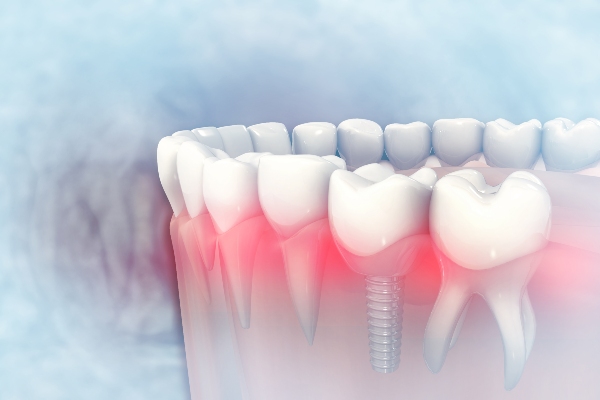
Tooth loss removes the dental root from the jawbone. This means that the jawbone does not have a stimulant anymore. The body does not receive signals to send nutrients to the jawbone for tissue repair. This leads to jawbone loss. Dental implants prevent this from happening.
The dentist cuts through the gum tissue and drills holes into the patient’s jawbone. Applying the titanium rods into the implant holes will follow. Then, the dentist will close the gum tissue over the rods by stitching it. This can help with the implant site’s healing. Dental implants can replace the lost dental roots that stimulate the jawbone. The stimulation signals the body to send nutrients to the jawbone for tissue repair and prevent jawbone loss.
Tooth loss leaves gaps in the dental arch. These spaces trigger the neighboring teeth to shift. Dental shifting can lead to dental misalignment. This can cause decay and instability in the patient’s bite. It may even develop into jaw pain and headaches.
Dental implants are popular sources of support for dental crowns and bridges. Each implant replicates a complete dental structure. That is why it looks, functions, and feels like a natural tooth. The titanium rod is the dental root. The dental crown stays on top of the rod by means of an abutment.
The support that dental implants need does not depend on the neighboring teeth. It depends on how the titanium rods merge with the gum tissue and jawbone. A dental implant can function on its own and stand alone. It will not move from its place once the titanium rods become one with the dental components.
It will take about three to five months for the dental implants to finish the fusion and recovery. This creates a strong base for these restorations. This process is osseointegration. Temporary dental crowns can protect the areas while the titanium rods fuse.
After the complete fusion, connecting the abutments will be next. The dentist will cut through the gum tissue to expose the top of the rods. Then, the abutments will attach to them. These titanium parts will connect the dental crowns to the rods. Stitching the gum tissue around the abutments will help these areas heal.
After about two weeks of healing, the dentist will attach the dental crowns to the abutments. The dentist will use strong dental cement in attaching the dental crowns. This will give the patient a stable and strong bite. Dental implants can last for decades with proper care and maintenance.
Check out what others are saying about our dental services on Yelp: Dental Implants in Denver, CO
Dental implants are stable and strong dental replacements. They function and look better than temporary options, while also outlasting all other alternatives. Working with your dentist can maintain the healthy condition of your dental implants.
Request an appointment or call Integrity Family Dental at 303-337-3000 for an appointment in our Denver office.
Cosmetic dentistry is not just for those in the public eye but is available to…
An implant dentist is a professional who diagnoses, plans, and places dental implants to restore…
With a dental implant, the patient can maintain the quality of their permanent replacement tooth…
An implant dentist can help people who are missing one or more teeth restore the…
An implant dentist often provides crucial support when a dental implant sustains damage that could…
Proper care is essential to maintain oral health, whether a tooth is treated with a…